Sonic HQ / Comics / Reviews / Archive / Sonic Super Special #3
|
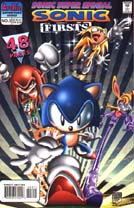
Sonic Super Special #3: Sonic The Hedgehog Firsts "Don't Cry For Me Mobius... (Sonic #1 Miniseries)" "Memories light the corners of my mind....
Lately there have been some on the Sonic lists who have been
observing ("whining" may be a more appropriate word for it) that
the comic seems to have taken a rather grim turn since "Endgame":
Mobitropolis is in shambles, the populace is divided along "racial"
lines and being slid into a "civil war", and Sonic is disaffected.
It's kind of unsettling to hear people talking about a period
dating less than five years ago as if they were "the good old
days." But just how good were they?
In that respect, Archie has done fans a great service by
reprinting four stories from the early days of the comic, covering
a period between February 1993 and August 1994. By taking a look
at these reprints, we realize that nostalgia ain't what it used tobe.
"Misty watercolor memories of the way we were....
For one thing, these stories are NOT bona fide reprints. Like
the protagonist of George Orwell's "1984," Archie has taken some
"liberties" with the past. The most obvious change (obvious to
anyone who still has those rare issues and looks at the pages side-
by-side) is in the character of Princess Sally. Aside from her
gradual makeover in the course of the book's development (not only
has her hair been restyled away from the ponytail on display here
and her muzzle fur more highly defined and her general contours
become more adult--especially after Pat Spaziante got through with
her!), she's no longer red with yellow headfur! That WAS the color
scheme in her first appearance in "Don't Cry For Me, Mobius".
Archie DID change her looks after that...to pink with black
headfur! It was only by issue #16 that Archie got it right and
adopted the brown with auburn headfur color scheme from the "Sonic
the Hedgehog" TV series.
They sure didn't adopt much else from the superior Saturday
morning series. While the premise and characters of that series
found their way into the comic, the tone seems to have been taken
from the vastly inferior "Adventures of Sonic the Hedgehog"
syndicated series. This must have seemed like a reasonable
compromise at the time, enabling Archie to tie the comic to both
series while ignoring the serious difference in mood between the
two. The result, seen in hindsight, is jarring; it's like trying
to do "Midsummer Night's Dream" with the cast of "King Lear."
"Scattered pictures of the smiles we left behind....
This wasn't the only liberty taken. Rotor was consistently
referred throughout the comic's early days as "Boomer." It wasn't
until Sonic #6 that his name changed to "Rotor" and it wasn't
explained to the readers until the Sonic-Grams of issue #29 that
"Boomer" was Rotor's nickname. A rather convincing rewriting of
history; Orwell would have been proud.
"Smiles we gave to one another of the way we were....
Having said that, there is a discernable tension just below
the rather frothy surface of these early comics, as if the writers
(or more specifically "writer" since three of the four stories on
display were scripted by Mike Gallagher) recognized the superiority
of the Saturday morning continuity but couldn't quite bring
themselves to plunge headlong into it. The most serious example is
the odd little interlude with Sonic and Sally at the top of page 6
of "Don't Cry For Me, Mobius." It's as if Gallagher WANTED to make
more of the Sonic and Sally relationship but couldn't quite bring
himself to do so. Of course, in these early days, he may not have
been sure where things were going so his approaches were
consciously tentative. By the time Gallagher scripted "Sonic
Blast," the relationship was more established and the exchange
between Sonic and Sally in THAT story (I'm thinking of the "You
know how to bristle" sequence) has a freedom that's visibly lacking
in these early efforts.
"Can it be that it was all so simple then/Or has time rewrittenevery line....?
But let's look at the stories themselves. Ever since "Taking
the Fall" (Sonic #47), the title "Don't Cry For Me, Mobius" has
taken an ironic twist. Every time I read it I picture Sally
standing on a balcony in a strapless evening gown singing:
Don't cry for me, freedom fighters
The "crying" of the title, as it turns out, comes from some
literally "weeping willows" who, because of Robotnik's recent
deforestation efforts, "have been crying for their fallen friends
ever since." This is an extraordinarily poetic touch; it reminds
me of the scene in "The Last Battle" (the final installment of C.
S. Lewis's Chronicles of Narnia) where a dryad -- a wood spirit and
the embodiment of a tree -- vanishes when her tree is cut down.
Too bad the rest of the plot couldn't live up to the premise; it
features Sonic being chased by Robotnik and Sonic defeating
Robotnik. The artwork by Scott Shaw! helps set the light tone for
the piece, and for Dave Manak's subsequent work on the series. Yet
I can't forget that "weeping willow" premise -- it carried at least
as much promise as "Growing Pains, Part 1" (Sonic #28) before THAT
story arc headed south in the following issue.
"If we had the chance to do it all again/Tell me would we? Could we....?
For my money, the last story in the issue, "This Island
Hedgehog", is the most interesting. An early story by Ken Penders
and former collaborator Mike Kanterovich, it introduces Knuckles,
"last of the Echidna" (little did HE know!). The important thing
here is the character of Knuckles himself: here he's all
belligerence with some of Sonic's jargon thrown in for good measure
(with phrases such as "put the snatch on the jewel" and so forth).
The plot of playing Knuckles off against Sonic and Tails is a bit
more complex than the other reprints on display, but what's most
noticeable of all is how one-dimensional Knuckles is here compared
to where he is now. He may have more on his mind these days what
with villains like Enerjak and the presence of Julie-Su and his
"relations" with the other Guardians (not to mention the re-
appearance of his mother) and.... You get the idea. This story
originally appeared in Sonic #14; in the space of a few short years
a character who could have been stuck with being a bit player and
occasional "friendly nemesis" -- the role he got stuck with for the
longest time, basically just waiting around for Sonic to drop by so
he could take a swing at the hedgehog -- is now at the center of an
EXTREMELY well-written and drafted series of his own. Can anyone
sincerely believe that the changes Knuckles has gone through in the
last three years have been for the worse? Do the fans really want
a return to THIS?
"Memories may be beautiful and yet....
There are a LOT of problems with "Rabbot Deployment," not
least of which is the character of Bunnie herself. I have to cut
Gallagher and Manak some slack here because this story was written
and drawn before the Saturday morning series debuted. They had no
way of knowing that thanks to the DiC writers and Christine
Cavanaugh's gifted voice work on the series, Bunnie would blossom
into one of the mainstays of the Sonic continuity. Here, she
starts out as a kind of orange rabbit with no discernable bustline
until the improbably bantering SWATbots toss her into the mobile
roboticizer. So what we've thought all along was the top of her
body suit turns out to have BEEN her bod!? Nice try, Dave, but I'm
not buying it. On page 6 of the story she literally goes from
unconscious to wisecracking in the space of ONE PANEL. And
unfortunately, Gallagher not only has supplied her with a generous
helping of Southern fried cliches (as he later would in "Rage
Against The Machine" in Sonic #39, part 1 of the Mecha Madness
story arc), he insists that her ultimate desire is to become a
hairdresser to royalty. Why didn't he just name her "Lurleen" or
something else equally connotative of "trailer trash" and get it
over with? This is NOT the Bunnie we've come to know and love,thank goodness!
Yet even HERE there are some interesting foreshadowings:
Bunnie asks about Antoine in a possibly less than casual way, and
she's established as knowing something about martial arts. Still,
fanfic and even Mike Teitelbaum's book "Robotnik's Revenge" takes
the issues of being partially roboticized a little more seriously
that Mike Gallagher does here. And of course, Ben Hurst definitely
threw a monkey wrench into this continuity when, in "Blast To The
Past," he showed a child Bunnie (with ribbons in her ears) as one
of the children who managed to escape with Rosie to Knothole when
Robotnik took over. Reprinting this story now only serves to muddy
the waters even further with regard to Bunnie's origins and leaves
the question up in the air. On the bright side, now that
Robotnik's out of the picture I don't see Bunnie talking about
opening up a beauty parlor in Mobitropolis with a name like "CurlUp 'N' Dye."
"What's too painful to remember we simply choose to forget....
"Lizard of Odd" is the least justifiable reprint of the bunch,
and the greatest cause for being grateful that these stories do NOT
represent the current state of comic book affairs. Sonic takes on
Universalamander, an ordinary lizard turned into a mecha-Godzilla
by Robotnik. When Universalamander pops him into his mouth, Sonic
escapes by...running around inside the lizard's mouth. There's GOT
to be more to it than that, and Mike Gallagher HINTS at the reason
why this is a "humiliation" of the Big U.: Sonic gratuitously says
"I'm cookin' with GAS!", Crabmeat refers to Robotnik in the very
first panel as "Oh flabulant one", and the last panel of the story
centers on a totally pointless scene of Super Sonic humiliating
Antoine with a whoopie cushion. Not even Puumba would be able tostomach THIS!
Even more inexcusable is the presence of Super Sonic. It's
yet another tie-in to the video game (and there's some of that on
display in EVERY story here), and let's face it, WHAT'S THE POINT
OF TURNING SONIC INTO SUPER SONIC? I've had someone ask me if I
was ever going to do a fanfic about Super Sonic; my answer was that
I saw no reason to do so because there's no drama inherent in the
transformation. Sonic is ALREADY "the fastest thing alive." Aside
from looking like a lemon drop, he doesn't do much as Super Sonic
that he doesn't do AS Sonic. It was a useless exercise.
Rating: N/A "So it's the laughter we will remember
So why the nostalgia all of a sudden? Perhaps the answer lies
in two recent purchases I made. While at the Fall Motor City Comic
Con, I bought two pages of Sonic comic sheets from Rich Koslowski.
One, from "Sally's Crusade" (In Your Face" special), showed Sonic
and Sally married, two pint-sized versions of themselves underfoot,
and King Acorn made whole. Kanterovich and Penders had to back
away from this idyllic look into the future under pressure from the
Sega plotmeisters, yet it was such an agreeable vision ("...and the
children have a grandfather") that I've never forgotten it.
Likewise, I bought a page of "When Hedgehogs Collide" (#24) showing
Sally in gypsy get-up trip-wiring the Antisonic's hog.
Recently, under the doctrine of Loose Continuity, the endings
of stories have gotten soft. In "Running to Stand Still" (#54) and
"Rise of the Robians" (#55), Karl Bollers uses the device of a call
on a communicator to signal a transition more than a conclusion.
Likewise, in "Sounds of Silence" (#53) Naugus vanishes and we're
left wondering, along with the Mobians, when and where he'll strike
next. It's as if the Loose Continuity notion is anchored in the
words of Shmendrik the Magician from Peter Beagle's "The Last
Unicorn": "There are no happy endings, because nothing ends."
These reprinted Sonic stories DO have happy endings (except
for "Lizard of Odd" which has a SAPPY ending). They also have no
sense that these characters have hearts or souls or lives. Once
the ball got rolling and the writers got a taste of the Saturday
morning feel for things, they were able to turn out more than just
eye candy. "Sally's Crusade" and "When Hedgehogs Collide" had
happy endings as well, but they ALSO had a greater feel for the
characters and made us CARE about them more than the stories
reprinted in "Sonic Firsts." I can see fans wanting a return to
THAT level of storytelling, but NO WAY can Archie's stable of
writers and artists backtrack to the Gallagher/Manak style comics
of almost five years ago. It'd be the saddest thing of all, like
watching Ronald Reagan's Alzheimer's disease getting worse.
"Whenever we remember the way we were....
"Sonic Firsts" has a certain curiosity value, due to the fact
that these were first attempts made by the Archie crew. It's
greatest value, though, is to highlight just how far we've come
since those days. Whatever the faults of the recent stories and
even of "Endgame," Archie has defied the odds and kept the title
alive after the tie-in TV show stopped production (the conventional
wisdom is that the comic should have died shortly after the show --
this is the same "conventional wisdom" that gets lampooned in
"Dilbert" on a regular basis). My own belief is that the writers
and artists have to remain true to the characters to keep things
going for another five years. Those characters are the heart of
the Sonic continuity, which has taken on a life of its own now. No
matter what Sega does with the games, Sonic and Knuckles and the
whole gang (even Princess Sally, much to Sega's chagrin) now exist
in their own right. "Sonic Firsts" reminds me of the title of Otto
Bettmann's landmark pictorial history of the late 19th Century:
"The Good Old Days...They Were Terrible!"
"....the way we were."
|